Quotation checklist
What to include in an EMS OEM quotation brief
Build an EMS OEM quote request with the product, quantities, branding, app, documents and delivery details suppliers need.
Give the supplier enough to quote the same project
"Please quote an EMS suit" is a beginning, but it leaves the manufacturer to guess the garment, controller, quantity, branding and delivery scope. Different assumptions can produce quotations that are difficult to compare.
Start with four essentials: your company, the product, the quantity and the customization you want. MacroSea requests these details for a quotation. Add the intended market and any known schedule so the discussion can move toward a useful configuration and project quote.
You do not need every detail finalized. Mark requirements as confirmed, preferred or still open, and ask the supplier to identify decisions needed before it can price an item.
1. Define the product and what counts as a set
Name the model or describe the product you need: full body suit, top, shorts, long pants, belt or pads. State who will use it and whether the purchase is for a brand, distributor or studio. Include preferred sizes and quantities by size if known.
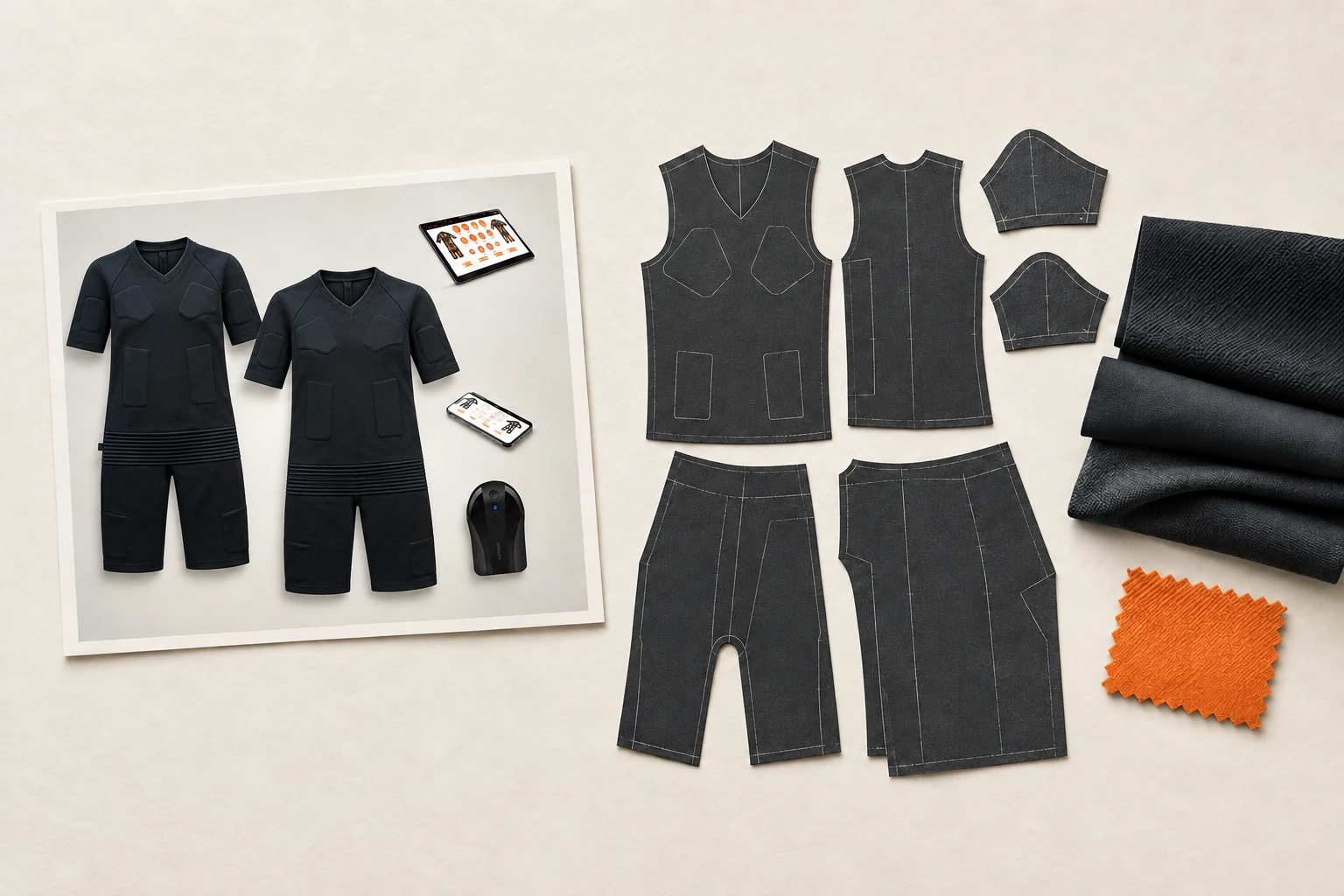
Specify the controller and how users should operate it. The 2011 shorts, for example, use the 2011 controller and MBODY app; the 902K shorts use the wired 902 controller without an app, while the 2105 shorts use the compact wireless 2105C controller without an app. The three controller families are not interchangeable. A request for "wireless shorts" alone may not capture the experience you need.
List the contents expected in one saleable set. MacroSea's general standard set includes a garment, controller, charging cable, small spray bottle and manual; confirm the exact contents for the model. Tell the supplier if you need additional controllers, spare garments or different packaging.
2. State quantity and customization separately
MacroSea offers paid samples of products in stock. Give a sample quantity and a planned initial order quantity. If you want prices for more than one quantity, list each quantity and size mix so every supplier is pricing the same scenarios. Ask for the applicable minimum order and whether it varies by model, size, color or customization.
For branding, attach or describe the logo file and placement, preferred garment colors and fabric, package artwork, manual language and any design changes. Ask which options are already available and which require development, mockups, tooling or sample approval.
If a dedicated app is part of the project, include its requested UI and functions, target languages, publishing account and update expectations. Membership can be included in a dedicated app; MBODY has no membership feature. Discuss custom development fees with sales. MacroSea requires at least 100 garment-and-controller sets for custom app development; this is not the minimum for every product. General product minimums and lead times are quoted by model and project.
3. Include market, documents and delivery requirements
List the countries of sale, intended use, manual languages, labeling and any documents you need. Request reports and declarations for the selected configuration; the European Commission's CE marking guidance explains how applicable EU product rules relate to documentation.
For delivery, give the destination, requested shipment timing and the delivery term you want quoted. Include the named place with any Incoterms rule. For example, FCA at a specified place in Shenzhen and a delivered price to a European warehouse assign different parts of the journey and cost to the parties. If you do not know the preferred term, ask the supplier to explain the available quotation bases.
If your retailer requires barcodes or a particular carton label, include that requirement as well. GS1 distinguishes product variations such as different sizes and colors when assigning trade item identifiers; agree on who supplies the identifiers and artwork for each version.
4. A hypothetical brief you can adapt
Example brief for a fitness equipment brand:
- Company and market: A fitness equipment brand selling in Germany; intended use and planned marketing claims to be supplied.
- Product: 2011 full body suit with compatible controller and standard accessories; confirm the exact set contents.
- Quantities: Two sample sets, followed by a planned first order of 120 garment-and-controller sets. Proposed size mix: 30 each in S, M, L and XL.
- Customization: Brand logo on the garment and packaging; supplier to provide a mockup and identify available color and fabric choices.
- App: Request a dedicated app in English with specified screens and membership functions. Discuss feasibility, account ownership, development scope and update responsibilities.
- Documents and delivery: Identify relevant documents for the intended market and quote FCA at a named place in Shenzhen under Incoterms 2020, with sample and production timing stated separately.
Attachments might include a logo file, preferred packaging reference and a brief list of app screens. This gives the supplier a clear product, controller and branding scope to price.
5. Ask for a quotation you can compare
Request a breakdown that distinguishes the price per set from one time charges such as samples, artwork, development, tooling or app work when applicable. Ask the supplier to identify included accessories, packaging and documentation, plus any freight or other charges included under the stated delivery term.
Compare quotations against the same model, quantities, size mix and customization. Align the controller, accessories and app scope before comparing prices. Ask the supplier to identify optional items and assumptions so you can revise the brief or request a consistent scope.
Also confirm the sample and production lead times, their starting points, payment terms and how long the offer remains valid. A useful quote makes clear which approvals must happen before production begins.
6. Move from a quote to an approved project
Review the proposal with the people responsible for product, operations and sales. Resolve any open points about garment fit, controller, app, documents and packaging, then agree on the sample and artwork approval process. For an existing branded product, MacroSea follows a sequence of logo submission, brand mockup approval, bulk production, inspection and shipment. New product development adds design confirmation, sampling, customer testing and revisions before production against the approved sample.
Whether you are starting with an existing product or a new concept, a concise brief gives the supplier the information to suggest a route and quote the work. Explore the product range, review OEM and ODM options, or send your requirements to discuss a quotation.
Put it into practice
Explore the products and process.
Sources and further reading
Product and service details also draw on MacroSea's catalog and manufacturing brief. External references were read on October 30, 2026.
- U.S. International Trade Administration: Know Your Incoterms
Explains how Incoterms rules allocate delivery obligations, costs and risks, and why the named place matters.
- Your Europe: CE Marking
European Commission guidance on identifying applicable rules and preparing product technical documentation and declarations.
- GS1: GTINs for products with multiple sizes and colours
GS1 guidance on assigning identifiers to product variations, including size and colour combinations.
- NIST MEP: Supplier scouting request
Supplier scouting form listing product specifications, volumes, materials, certifications, delivery and packaging requirements.